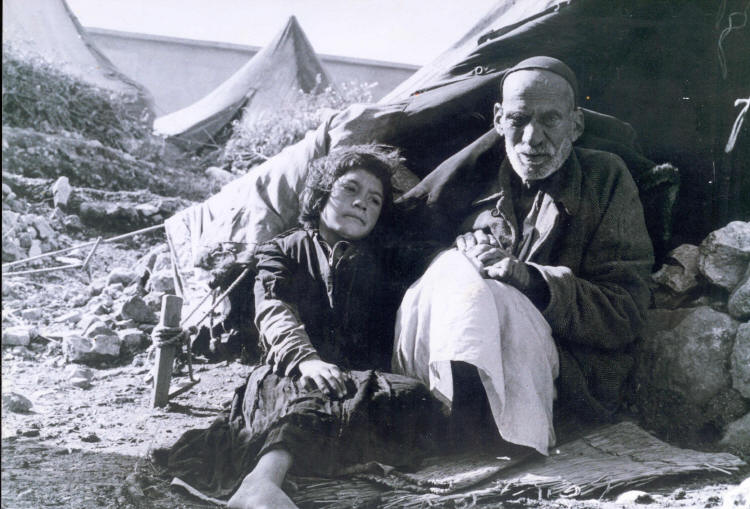
Palestinian al-Nakba refugees, 1948
One of the most fascinating predicaments with the Western world's involvement in the Middle East is precisely our lack of knowledge regarding the specific histories, cultures, religious dogmas, and political standpoints of the numerous ethnic groups within the area. The extreme American lack of global awareness and sensitivity becomes particularly relevant in discussions regarding the Palestinian and Israeli conflict. Distortion of information regarding the United States' and other Western powers' presence within the Middle East--a term that is problematic in its own right--has prepetuated a hegemonic cultural view of this region that legitimizes Western power within the region while simultaneously rendering the indigenous cultures mute. Furthermore, we are presented with this misinformation not only from U.S. political parties, but within the educational systems and media outlets as well.
Within our own history, Israel is triumphed as a nation of democracy and a powerful ally of the United States within the Middle East; however, we have never been informed to the true history of the region. Hailed as a sanctuary and a pseudo-atonement for the atrocities of WWII, the forced creation of Israel is presented within America as a sort of ethnic/religious salvation for the Jewish people; however, none of us are educated towards to true history of this region. As a consequence to the formation of Israel, Palestinian Arabs, numbering anywhere from 650,000 to 750,000 people, were forced from land that Western powers declared to be "unoccupied". (How any land during the 20th century could be completely devoid of human population is a question in its own right). The call for Zionism resulted in a diaspora for the Palestinian Arab peoples. In Palestinian history, this period, lasting from December 1947 to March 1949, is referred to as al Nakba--an Arabic word meaning disaster, catastrophe, or cataclysm. The formation of Israel as a nation state resulted from the forced exodus of 80 percent of the native population of the region.

Make-shift school at refugee camp, 1948
Military historian, Edgar O'Ballance comments: Israeli vans with loudspeakers drove through the streets ordering all the inhabitants to evacuate immediately, and such as were reluctant to leave were forcibly ejected from their homes by the triumphant Israelis whose policy was now openly one of clearing out all the Arab civil population before them …. From the surrounding villages and hamlets, during the next two or three days, all the inhabitants were uprooted and set off on the road to Ramallah…. No longer was there any "reasonable persuasion". Bluntly, the Arab inhabitants were ejected and forced to flee into Arab territory…. Wherever the Israeli troops advanced into Arab country the Arab population was bulldozed out in front of them.
My question now is this: if the goal of U.S. political system is purportedly to achieve peace within the Middle East and specifically a resolve to the Palestinian-Israeli Conflict, how could this ever possibly be accomplished when the history of the region is hidden for the public? Perhaps, like so many other aspect of American history, the truth is being obscured because it is simply too ugly, violent, and distorted to be acknowledged. Yet, the fact remains that ethnic cleansing occurred with European-American sanctioning which raises further questions regarding our political presence and militaristic support of the Israeli people. What are our true intentions within this region?


I like your last set of questions and I have one to go with it: Should that be the United States goal, especially when there is so little understanding of anything "Middle East"? I feel like we cannot just say to Israel, "Hey we give, you are on your own now" but at the same time, what good are we doing there? I think its funny that our nation's goal is peace for Israelis/Palestinians when we assisted in the creation of the conflict.
ReplyDeleteThese are powerful questions, Philip. It is time that they received answers.
ReplyDelete