04 November 2009

Shafak on Fiction and Translation


I found this story today on NPR and must say that listening to Shafak speak about her writing and translation really helps understand her approach to literature.  Within the recording, Shafak outlines the importance of the writing process to her stating roughly that fiction is the ability to transcend your own self and move into another person's shoes, to experience life from their point of view, and therefore can cross the boundaries of race, class, religion, gender, ethnicity, and all other sort of binarisms.  This point is extremely interesting in regards to the ways in which American's generally conceive of fiction.  Usually we believe or expect some aspect of authorial truth within fiction.  Think of the myth that fiction or poetry must be some sort of reflection of the inner soul, something you feel so passionately about that you must  pour onto the page.  For Shafak, this is not the way in which fiction works.  To a certain extent Shafak's definition of fiction as a method of traveling outside of ourselves and into another person's world is perfect for a class on Post-Colonial Literature, but I still question the degree to which Shafak removes herself from her work. Immediately after stating that fiction is a sort of metaphysical embodiment of another person, Shafak continues to state that everything in her life permeates her work.  She cites the example of teaching in the classroom and finding a question a student asked reappear within a text.  Obviously, Shafak's writing is both an exploration of transcultural boundaries as well as a reflection of her own beliefs. 

Shafak also speaks within the interview on the subject of language and states that translation and writing are completely different phenomena.  A translator is charged with the task of repeating rhythems, cadences, and patterns found within one language in the translation.  This task, as Shafak asserts, is simply impossible to do without changing the meaning of the text to a great degree.  Shafak also states that when she writes in Turkish as opposed to English she discovers a different authorial voice.  In this manner, Shafak's conceptions of language mirror those of her writing allowing her to essentially explore aspects of agency and identity within her work as well as the processes of writing.

23 October 2009

Time of Favor

The film "Time of Favor" grapples with questions of identity and agency within contemporary Israeli society.  Because the film takes place within a settlement outside of the dividing line of Israel and Palestine, it offers an interesting glimpse into the ways in which Israeli citizens view their lives and religion.  Rabbi Metzer, who encourages the migration and settlement of Israeli people upon Palestinian land makes the comparison that it is better to be a "dead lion" than "a living dog".  This metaphor truly struck me as powerful as it encapsulates the passion with which these groups feel towards their cause; however, the Rabbi's intentions in the statement are read by Pini as a call for martyrdom.  The true voice of reason and mediation throughout the film is that of Michal who, despite the trauma she has been through, maintains her religion without becoming overwhelmed by extremism.  The lines between idealism and extremism blur within the film and is possibly represented by the contrasts with light and shadow as well as the general inability to see throughout the film.

19 October 2009

United Shapes of Ambivalence


The work above by Kim Dingle illustrates a theme that we have been discussing in class: American ambivalence to mere geography.  Within Untied Shapes of America (Maps Drawn by Las Vegas Teenages), Dingle takes actual drawings of the United States produced by teenages and collages them together to make a statement about America's lack of knowledge regarding geographical locations.  Variations on America include: enormous representations of Florida, a couple without Michigan, and , one that resembles South America.  While I have to admit that if I were to draw a map of America, the northern boarders of the nation may be shaky, it seems that teenages should be studying this as a part of their education; yet it appears that many students are not even required to have any sort of knowledge as to how their nation is shaped.  Although this article from BBC News may be slightly dated, it does reveal some fascinating facts about American's knowledge of world geography.  The article summarizes a survey done by America's National Geographic Society that tested the geographical knowledge of 3,000 young adults (ages 18-24) from nine different countries.  American's place 8th in geographic knowledge.  This sort of basic geographical knowledge shows that Americans are completely apathetic or else undereducated in regards to mere geophrical information.  Furthermore, if these are the results from a geographical survey, I wonder what the results of a more political survey would reveal.  According to the survey:
  • 11% of Americans could not find America.
  • 71% of Americans could point out where the Pacific Ocean - the world's largest body of water - was located. Worldwide, three in 10 of those surveyed could not locate the Pacific Ocean.
  • Apart from the Swedes, only 40% or fewer young adults could name China and India as the two countries with a population over one billion.
  • Less than 25% of French, Canadian, Italian, British and Americans could name four countries that officially acknowledged owning nuclear weapons.
  • 58% of Americans know the Taleban and al-Qaeda were based in Afghanistan, compared with 84% of Britons, but only 17% of Americans can locate the country.
  • 34% of Americans know the tiny Marquesas Islands, where the last season of reality TV show "Survivor" was filmed, is located in the South Pacific. But only 30% could point to the location of New Jersey.
  • 56% of Americans were unable to locate India, home to 17% of the world's population. 

Literature in Translation

The discussion that we had in class last Thursday once we reconvened from our separate groups helped to shape the course of our discussions for the upcoming readings.  Because of the difficulties that are encountered when literature is translated from its original language into another, the question of translation must always be at the forefront of our thoughts when we read this type of literature.  Here is a video that I found online of  the last four winners of Independent Foreign Fiction Prize.  These authors, although none of them speak to the difficulty of translating texts from Arabic into English, outline some of the difficulties that we discussed in class.  Its fascinating to me that some of these translators have never even been to the country that they are translating literature from.  Without a knowledge of these countries cultures, it seems unlikely that the translation would mirror the author's original text; rather, without this first-hand knowledge even with the help of email, the translation will necessarily loose some of its original power.

17 October 2009

An Extremely Concise Timeline of the Israeli-Palestinian Conflict

1897—World Zionist Organization founded in Switzerland
1917—Balfour Declaration (British) promises “National Home” for Jewish people in Palestine
1919—Fall of the Ottoman Empire; Region under British control
1948—Al-Nakba (or Israel War of Independence): declaration of Israel as the Jewish nation-state (UN Partition Plan);  British withdrawal from Palestine; Egypt, Syria, Iraq, Lebanon, Jordan, and Saudi Arabia declare war on Israel.
1949—Armistice between Israel and Arab states; Israel gains 50% more territory than originally allotted in UN Partition Plan
1956—Suez Campaign: Israel invades Sinai Peninsula with French & British.  Fear of Egyptian alliances with the Soviet Union
1964—Palestinian Liberation Organization founded; previously were only considered to be refugees or were under the jurisdiction of either Egypt or Jordan
1967—Six Day War (June 5th-10th): Israel invades and occupies Sinai and Gaza (from Egypt), the West Bank (from Jordan), & Golan Heights (from Syria).  UN Resolution 242 calls for Israeli withdraw from occupied territories base on UN Partition Plan
1967—Allon Plan proposed
1968—PLO Covenant: “Palestine with the boundaries it had during the British mandate is an indivisible territorial unit”
1973—The Yom Kippur War: Syria & Egypt lead invasion of Israeli occupied territories
1974—Rabat Summit & UN General Assembly Resolution 3236: PLO named sole representatives for the Palestinian people; Palestinian National Council Program: Palestine willing to consider a solution other than full return of all territory
1976—Palestinians achieve observer status in UN
1974-88: Arab states represent Palestine in conflict resolutions
1979: Israel-Egypt Peace Treaty: Egypt first Arab country to officially recognize Israel
1987-1992—First Intifada: civil disobedience, violence, against Israeli occupation of Palestine
1988—formal withdrawal by Jordan from West Bank affairs; independent State of Palestine proclaimed by the Palestinian National Council
1992-2000—Continued peace negotiations, sectarian resistance/violence
1993-95—Oslo Accords: Israel and PLO mutual recognition; Palestinian authority to be established
1993—Declaration of Principles signed by Israel & Palestine: two-state solution
1994—Israel-Jordan Peace Treaty
2000-2009—Second Intifada: continued resistance to Israeli occupation, encroachment of territory

15 October 2009

Continued Conflict: Settlements & Jerusalem

Last week, we discussed the history of the Israeli-Palestinian conflict and the problems that arise when the question of statehood and power relations are introduced.  As outlined by the history of the conflict, there has not been a formidable solution to the territorial disputes due to Israel's failure to recognize Palestine as a legitimate nation-state as well as Palestine's continuous demand for all of its territory back.  During the Obama administration's first year, the conflict has continued with little progress due to Israeli settlements continuously encroaching upon Palestinian claimed territory.  In September, Obama spoke in Cairo to these developments and specifically called for Israel to officially condemn these settlers; however, the Israeli government has yet to issue such a statement.  Rather than cease the building of these settlements while negotiations are happening with Palestine, Israel has stated that it has no intentions to stop its citizens from future developments and states that the delineation of national boundaries should not be negotiated until the two nations can reach a peace agreement.  Israeli encroachment upon Palestinian territory has recently lead to chastising remarks from the United Nations, the European Union, as well as various countries within the Middle East.  To me, the failure of the Israeli government to acknowledge the illegitimacy of these settlements underscores their continuing history of denying Palestinian authority and nationhood.  The imbalance of power that favors Israel has continued with the flagrant disregard for the Oslo Accords which may explain the hostility of Hezbollah and Hamas.  If Israel truly wished to succeed in peace negotiations, they must alter their approach to Palestine by recognizing it as a legitimate power and make strides towards defining the boundaries between the nations and be prepared to enforce these boundaries amongst their own citizens.

06 October 2009

House of Sand and Fog


I've been doing a lot more thinking about cinematic representations of Middle Eastern people and culture this week and, while the film does not speak to American attitudes towards Palestinian or Iraqi persons, House of Sand and Fog (2003) does offer some interesting insight that correlates with Shaheen's Reel Bad Arabs.  As Shaheen observes, there exists a prevalent attitude in American culture that speaks to the fear that persons of Middle Eastern descent are slowly attempting to purchase America through slow and systematic land acquisitions. House of Sand and Fog essentially positions former home owner Kathy (Jennifer Connelly) against Iranian immigrant Massoud Amir Behrani (Ben Kingsley) in a war over the property that Kathy once owned.  When Kathy the property mistaken seized by the state, Behrani and his family purchase the home and proceed to renovate it.  Kathy and Behrani are thrust into a property battle that spirals into a racial profiling and accusations.  Throughout this process, Kathy befriends a police officer whose ideas of what constitutes an American lead him to attempt to intimidate the Behrani's into leaving the property and ultimately leads to the death of Behrani's son.  Throughout the film, American ideas of Middle Eastern persons become quite explicit.  The Behranis are accused of being terrorists, illegal aliens, and attempting to steal land and money from Kathy.  As Shaheen points out within his film and cinematic guide, Reel Bad Arabs, these portrayals of the Behranis are consistent with racist ideologies within American society.  While the film was enormously successful, particularly within the Academy, its portrayals of Arab Americans are ripe with bigotry and subsequently must lead us to question how American popular entertainments present Arab Americans.

01 October 2009

Palestinian Literature Readings

For the discussions of Palestinian literature and culture that Diane and I will be leading, the following texts/films will be used:


One novel: The Lake Beyond the Wind by Yahya Yakhlif, or The Image, the Icon, and the Covenant by Sahar Khalifeh for Oct 15th.


View: Paradise Now by Hany Abu-Assad for Oct 8th.


Read: "Bridging the Gap: Palestinian and Israeli Discourses on Autonomy and Statehood" by David Newman & Gazi Falah (available through the Waldo library database) for Oct 8th.
 
Also: if you decide which book you would like to read, please leave a comment letting Diane and myself know which book you choose.  This way we can keep track of how many people are planning on reading which book.  Thanks!


Suggested: Palestinian New Network and CNN (or other comparable news sites).  Look for commonalities and differences in the ways in which news stories are presented for Oct 8th.


Even War Becomes Routine: Denying the War/Questioning the West


Within Baghdad Diary,  Nuha al-Radi's observations of the war from a civilian standpoint produce a compelling commentary upon the war that shows how war becomes something distant and unfathomable even to those who are experiencing it around them.  While the American government propagated the idea that the invasion of Iraq would be swift and unchallenged, it becomes evident within the earliest portions of the narrative that this was merely propaganda.  Al-Radi highlights by the tenth day of the war that the continuing strife would not be resolved as readily as the American government assured.  Combined with the diminishing water and food supplied that al-Radi speaks of, the speed of the war increased with such fervor that few people would have been prepared to deal with the consequences of the war.  When al-Radi's family member comments that the family should take a train out of Baghdad, al-Radi quickly asks why he would even think the trains were still running.  It becomes evident early on that no one was prepared for the war.  


Within al-Radi's family, the sense of denial is rampant.  The family throws a party for al-Radi's birthday that involves numerous neighbors and family members from Baghdad.  Al-Radi herself comments on the seventh day that, "The worst has happened--beer without ice".  Also, the image of Iraqi's bartering over a stray bomb that fell and did not explode within a hotel courtyard and their desire to keep the bomb as a souvenir further illustrate a denial of the war's occurrence.  Only as supplies run out, access to the outer world is cut off (via the destruction of bridges, lack of transportation, etc), and a system of supply trade emerges within Baghdad do the civilians begin to realize the impact of the war.


Throughout the text, a dialogue of difference emerges as al-Radi questions her position and feelings towards the Western world.  Early on, al-Radi asks if her family should flee to India and comments that Iraqis experience less oppression there than elsewhere.  Combined with the images of shelters, bridge destructions, and increased ghettoization within Baghdad, al-Radi's opinion of the West falls into ill favor.  As the war progresses, al-Radi's opinion of the West becomes more and more negatively influenced.  This raises numerous questions regarding the true intention of Western forces within Iraq. 


The most fascinating portion of the diary revolves around the dreams that al-Radi recounts throughout.  Images of bread trees, drying gardens, and soldiers marching down Haifa Street permeate al-Radi's premonition-like dreams.  Perhaps this is a location within the text that we could analyze using post-colonialism as a lens along within a Freudian or psychological perspective.  Overall, I find the reoccurring allusions to Western culture to be the most fascinating thematic issues within the diary.  Before the bombings become unquestionably violent, al-Radi compares the sound of the falling bombs to the music of Philip Glass.  Although this phenomena diminishes as the novel progresses, tracing the connections between the forward motion of the war, the references to Western culture, and changing attitudes towards the occupation would reveal how the war does not effect people as a binary but how it inspires a series of complex, multifaceted reactions.

29 September 2009

The Baghdad Diaries Project


While I was searching for The Baghdad Diaries by Nuha al-Radi, I stumbled across this project.  The goal of the site is to compile the journal entries of various persons involved in the Iraq War by circulating blank journals among any interested party.  Given the dates of the website and when it appears to be last updated, I'm not certain the project is still in motion; however, I think that such an undertaking could present a forum for people who would not normally be given prominent voices to comment upon the impact of the war.  Moreover, the site does appear to be geared towards soldiers in particular.  If this compilation project was opened up to all sorts of people and included the voices of American soldiers, Iraqi soldiers, civilians, mothers, nurses, reporters, laborers, etc, etc--basically anyone who is affected by the war--perhaps we could gain a great understanding of what is lost/won in the war, or what sort of cultural and psychological reactions the war is triggering among those experiencing it.  The website asks:


"Why a series of diaries? A diary conveys a certain sense of intimacy where we can offer an honest introspective dialogs and confess our hopes and doubts. As each diary passes from person to person, perhaps we'll find we have common hopes and doubts regardless of where we stand. How will this personal conversation affect each of us? Who knows? It may comfort some of us; it may alienate some of us and it may disillusion some of us. It may help some of us acknowledge the way our world has changed and come to terms with those changes. After all, this is a conversation about the world and our place in it. What do you have to say?"


Indeed, this is the question that the war triggers and something I think many American's have been grappling with: where is our place in the world?  Given the sort of global, political upheaval occurring and the disinformation/misinformation supplied by our government about the war, we must ask ourselves what is the true impact of such an atrocity?  What ramifications will this war have for political relations, or more significantly, cultural expectations.  This sort of project could highlight the differences between various social ideologies, but would ultimately allow for a great understanding of one another as fears, anxieties, and sacrifices are revealed.  Perhaps simply discuss the war and its effects can lead to coalition building; however, if we remain ignorant to alternative standpoints regarding the war, we will never be able to communicate effectively with one another.

24 September 2009

The Subaltern Speaks: Al-Nowaihi & Colonialism

Within her The "Middle East"? Or. . . /Arabic Literature and the Postcolonial Predicament, Magda M. Al-Nowaihi demonstrates how literature from the Middle East exemplifies the postcolonial problematics of the region; however, one of the most essential parts of her argument hinges on her refusal to refer to the text as an all encompassing.  Al-Nowaihi states, "Attempting to cover all this in an essay of 7,500-8,000 words risks homogenizing the differences and glossing over the specific histories and multiple contextual nuances of the peoples and cultures of this geographical area. . . This homogenization of the 'other' is itself on of the basic strategies of colonialism" (282).  By focusing mainly upon Egypt's history of colonization, political resistance, and literary tradition, Al-Nowaihi is able to produce a criticism of European colonial interests within the Middle East without overly essentializing any particular region's cultural praxes.  Unless the academic community at large takes heed of the methodology Al-Nowaihi implements, it will ultimately produce a form of intellectual colonialism that negates the differences between these specific groups.  I find Al-Nowaihi's observations of the changes within her own university (Columbia) to be especially telling of the sorts of changes that must be implemented to resist this intellectual colonialism.


As Western powers slowly colonized the Middle Eastern region, political and cultural ideology began to saturate the landscape.  Al-Nowaihi demonstrates how this simultaneous physical and ideological invasion and occupation influenced Middle Easter societies.  The literary struggle between autonomy/agency and community/solidarity "parallels the displacement of that warm communal life with a new lifestyle that is more affluent, but that is characterized by materialism, rampant consumerism, and personal greed. . . liked to the general changes brought about by the European powers" (290).  This struggle between Western and traditional belief systems are aligned with modernism and generally colonization.  An endlessly complex region before Western influence was imposed and injected into the cultures, the Middle East, as its literature demonstrates, is presented with a unique fusion of philosophies that must somehow achieve balance if the region is to remain a significant part of global economic and political systems.

Al-Alnakba: The Hidden Exodus


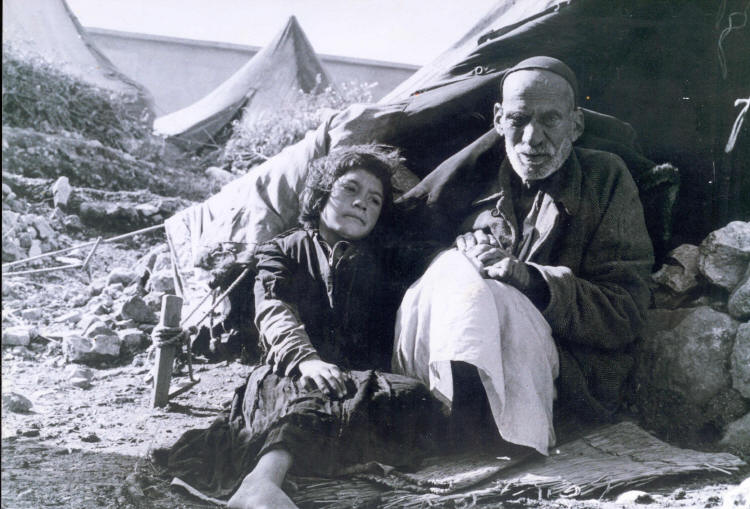
Palestinian al-Nakba refugees, 1948

One of the most fascinating predicaments with the Western world's involvement in the Middle East is precisely our lack of knowledge regarding the specific histories, cultures, religious dogmas, and political standpoints of the numerous ethnic groups within the area. The extreme American lack of global awareness and sensitivity becomes particularly relevant in discussions regarding the Palestinian and Israeli conflict. Distortion of information regarding the United States' and other Western powers' presence within the Middle East--a term that is problematic in its own right--has prepetuated a hegemonic cultural view of this region that legitimizes Western power within the region while simultaneously rendering the indigenous cultures mute. Furthermore, we are presented with this misinformation not only from U.S. political parties, but within the educational systems and media outlets as well.


Within our own history, Israel is triumphed as a nation of democracy and a powerful ally of the United States within the Middle East; however, we have never been informed to the true history of the region. Hailed as a sanctuary and a pseudo-atonement for the atrocities of WWII, the forced creation of Israel is presented within America as a sort of ethnic/religious salvation for the Jewish people; however, none of us are educated towards to true history of this region. As a consequence to the formation of Israel, Palestinian Arabs, numbering anywhere from 650,000 to 750,000 people, were forced from land that Western powers declared to be "unoccupied". (How any land during the 20th century could be completely devoid of human population is a question in its own right). The call for Zionism resulted in a diaspora for the Palestinian Arab peoples. In Palestinian history, this period, lasting from December 1947 to March 1949, is referred to as al Nakba--an Arabic word meaning disaster, catastrophe, or cataclysm. The formation of Israel as a nation state resulted from the forced exodus of 80 percent of the native population of the region.


Make-shift school at refugee camp, 1948


Military historian, Edgar O'Ballance comments: Israeli vans with loudspeakers drove through the streets ordering all the inhabitants to evacuate immediately, and such as were reluctant to leave were forcibly ejected from their homes by the triumphant Israelis whose policy was now openly one of clearing out all the Arab civil population before them …. From the surrounding villages and hamlets, during the next two or three days, all the inhabitants were uprooted and set off on the road to Ramallah…. No longer was there any "reasonable persuasion". Bluntly, the Arab inhabitants were ejected and forced to flee into Arab territory…. Wherever the Israeli troops advanced into Arab country the Arab population was bulldozed out in front of them.


More information: Al-Nakba, Plan Dalet, and 1948 Arab-Israeli War


My question now is this: if the goal of U.S. political system is purportedly to achieve peace within the Middle East and specifically a resolve to the Palestinian-Israeli Conflict, how could this ever possibly be accomplished when the history of the region is hidden for the public? Perhaps, like so many other aspect of American history, the truth is being obscured because it is simply too ugly, violent, and distorted to be acknowledged. Yet, the fact remains that ethnic cleansing occurred with European-American sanctioning which raises further questions regarding our political presence and militaristic support of the Israeli people. What are our true intentions within this region?


17 September 2009

Harum Scarum: Middle Eastern Mythologies

Jack G. Shaheen’s Reel Bad Arabs demonstrates the ways in which mythological, Westernized assumptions about persons of Middle Eastern decent filter from Occidental political standpoints into popular culture.  The culturally misguided mythologies, unlike other racially biased suppositions, are allowed to continue on unchallenged due to political strains between the West and the Near East.  As Shaheen aptly comments towards the end of his documentary, the stereotype of the Arab is one that has endured centuries of sociopolitical change; however, unlike other caricatures of minority groups, the Arab is still used today in the same detrimental manner.  This sort of racialized sentiment towards person of the Middle East, as it is recycled and re-presented through Hollywood film, allows only for a miniscule, skewed representation of their culture, heritage, and belief.  Rather than offering a well rounded, contemporarily contextualized view of Middle Eastern culture, Hollywood constantly (re)presents the same stereotypes.  This repetitious, recycled racism informs Western conceptions of Middle Eastern identity which in turn controls the way we politically conceive of these people and their respective cultures.  Here Edward Said’s definition of what constitutes Orientalism proves particularly enlightening: “As much as the West itself, the Orient is an idea that has a history and a tradition of thought, imagery, and vocabulary that have given it reality and presence in and for the West” (Said 5).  As Said illustrates, the ways in which we conceive of the Orient as a Western culture are completely dictates by the corpus of knowledge that we have produced concerning it.  The perceptions of the Middle East that present Arab persons as racial inferiors stem from a historical viewpoint found within Western cultures that views Middle Eastern societies as lesser.  When combined with what Shaheen coins as Islamophobia, the traditional notions that the Arab world is uncivilized allow and promote bigotry within Western cultures.  The video that follows, from Harum Scarum (1965), demonstrates the prevailing conceptualizations of Middle Eastern culture as seen from a Western viewpoint.  The lyrics and imagery evoke the same repetitious myths found within the films that Shaheen speaks to: