29 September 2009

The Baghdad Diaries Project


While I was searching for The Baghdad Diaries by Nuha al-Radi, I stumbled across this project.  The goal of the site is to compile the journal entries of various persons involved in the Iraq War by circulating blank journals among any interested party.  Given the dates of the website and when it appears to be last updated, I'm not certain the project is still in motion; however, I think that such an undertaking could present a forum for people who would not normally be given prominent voices to comment upon the impact of the war.  Moreover, the site does appear to be geared towards soldiers in particular.  If this compilation project was opened up to all sorts of people and included the voices of American soldiers, Iraqi soldiers, civilians, mothers, nurses, reporters, laborers, etc, etc--basically anyone who is affected by the war--perhaps we could gain a great understanding of what is lost/won in the war, or what sort of cultural and psychological reactions the war is triggering among those experiencing it.  The website asks:


"Why a series of diaries? A diary conveys a certain sense of intimacy where we can offer an honest introspective dialogs and confess our hopes and doubts. As each diary passes from person to person, perhaps we'll find we have common hopes and doubts regardless of where we stand. How will this personal conversation affect each of us? Who knows? It may comfort some of us; it may alienate some of us and it may disillusion some of us. It may help some of us acknowledge the way our world has changed and come to terms with those changes. After all, this is a conversation about the world and our place in it. What do you have to say?"


Indeed, this is the question that the war triggers and something I think many American's have been grappling with: where is our place in the world?  Given the sort of global, political upheaval occurring and the disinformation/misinformation supplied by our government about the war, we must ask ourselves what is the true impact of such an atrocity?  What ramifications will this war have for political relations, or more significantly, cultural expectations.  This sort of project could highlight the differences between various social ideologies, but would ultimately allow for a great understanding of one another as fears, anxieties, and sacrifices are revealed.  Perhaps simply discuss the war and its effects can lead to coalition building; however, if we remain ignorant to alternative standpoints regarding the war, we will never be able to communicate effectively with one another.

24 September 2009

The Subaltern Speaks: Al-Nowaihi & Colonialism

Within her The "Middle East"? Or. . . /Arabic Literature and the Postcolonial Predicament, Magda M. Al-Nowaihi demonstrates how literature from the Middle East exemplifies the postcolonial problematics of the region; however, one of the most essential parts of her argument hinges on her refusal to refer to the text as an all encompassing.  Al-Nowaihi states, "Attempting to cover all this in an essay of 7,500-8,000 words risks homogenizing the differences and glossing over the specific histories and multiple contextual nuances of the peoples and cultures of this geographical area. . . This homogenization of the 'other' is itself on of the basic strategies of colonialism" (282).  By focusing mainly upon Egypt's history of colonization, political resistance, and literary tradition, Al-Nowaihi is able to produce a criticism of European colonial interests within the Middle East without overly essentializing any particular region's cultural praxes.  Unless the academic community at large takes heed of the methodology Al-Nowaihi implements, it will ultimately produce a form of intellectual colonialism that negates the differences between these specific groups.  I find Al-Nowaihi's observations of the changes within her own university (Columbia) to be especially telling of the sorts of changes that must be implemented to resist this intellectual colonialism.


As Western powers slowly colonized the Middle Eastern region, political and cultural ideology began to saturate the landscape.  Al-Nowaihi demonstrates how this simultaneous physical and ideological invasion and occupation influenced Middle Easter societies.  The literary struggle between autonomy/agency and community/solidarity "parallels the displacement of that warm communal life with a new lifestyle that is more affluent, but that is characterized by materialism, rampant consumerism, and personal greed. . . liked to the general changes brought about by the European powers" (290).  This struggle between Western and traditional belief systems are aligned with modernism and generally colonization.  An endlessly complex region before Western influence was imposed and injected into the cultures, the Middle East, as its literature demonstrates, is presented with a unique fusion of philosophies that must somehow achieve balance if the region is to remain a significant part of global economic and political systems.

Al-Alnakba: The Hidden Exodus


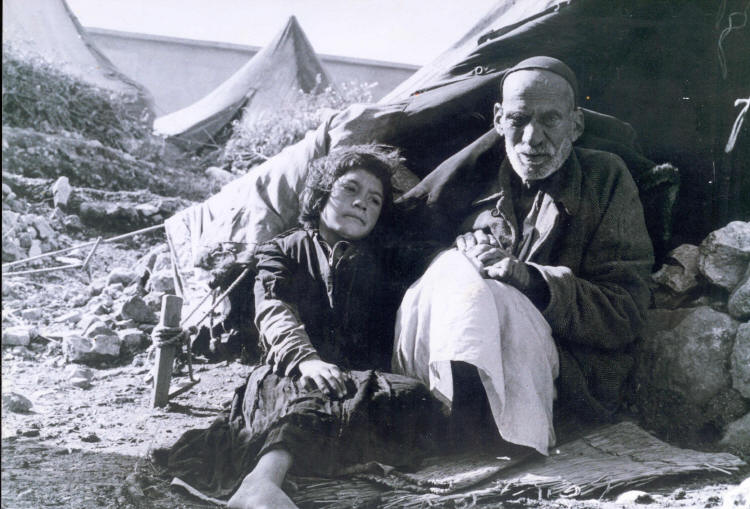
Palestinian al-Nakba refugees, 1948

One of the most fascinating predicaments with the Western world's involvement in the Middle East is precisely our lack of knowledge regarding the specific histories, cultures, religious dogmas, and political standpoints of the numerous ethnic groups within the area. The extreme American lack of global awareness and sensitivity becomes particularly relevant in discussions regarding the Palestinian and Israeli conflict. Distortion of information regarding the United States' and other Western powers' presence within the Middle East--a term that is problematic in its own right--has prepetuated a hegemonic cultural view of this region that legitimizes Western power within the region while simultaneously rendering the indigenous cultures mute. Furthermore, we are presented with this misinformation not only from U.S. political parties, but within the educational systems and media outlets as well.


Within our own history, Israel is triumphed as a nation of democracy and a powerful ally of the United States within the Middle East; however, we have never been informed to the true history of the region. Hailed as a sanctuary and a pseudo-atonement for the atrocities of WWII, the forced creation of Israel is presented within America as a sort of ethnic/religious salvation for the Jewish people; however, none of us are educated towards to true history of this region. As a consequence to the formation of Israel, Palestinian Arabs, numbering anywhere from 650,000 to 750,000 people, were forced from land that Western powers declared to be "unoccupied". (How any land during the 20th century could be completely devoid of human population is a question in its own right). The call for Zionism resulted in a diaspora for the Palestinian Arab peoples. In Palestinian history, this period, lasting from December 1947 to March 1949, is referred to as al Nakba--an Arabic word meaning disaster, catastrophe, or cataclysm. The formation of Israel as a nation state resulted from the forced exodus of 80 percent of the native population of the region.


Make-shift school at refugee camp, 1948


Military historian, Edgar O'Ballance comments: Israeli vans with loudspeakers drove through the streets ordering all the inhabitants to evacuate immediately, and such as were reluctant to leave were forcibly ejected from their homes by the triumphant Israelis whose policy was now openly one of clearing out all the Arab civil population before them …. From the surrounding villages and hamlets, during the next two or three days, all the inhabitants were uprooted and set off on the road to Ramallah…. No longer was there any "reasonable persuasion". Bluntly, the Arab inhabitants were ejected and forced to flee into Arab territory…. Wherever the Israeli troops advanced into Arab country the Arab population was bulldozed out in front of them.


More information: Al-Nakba, Plan Dalet, and 1948 Arab-Israeli War


My question now is this: if the goal of U.S. political system is purportedly to achieve peace within the Middle East and specifically a resolve to the Palestinian-Israeli Conflict, how could this ever possibly be accomplished when the history of the region is hidden for the public? Perhaps, like so many other aspect of American history, the truth is being obscured because it is simply too ugly, violent, and distorted to be acknowledged. Yet, the fact remains that ethnic cleansing occurred with European-American sanctioning which raises further questions regarding our political presence and militaristic support of the Israeli people. What are our true intentions within this region?


17 September 2009

Harum Scarum: Middle Eastern Mythologies

Jack G. Shaheen’s Reel Bad Arabs demonstrates the ways in which mythological, Westernized assumptions about persons of Middle Eastern decent filter from Occidental political standpoints into popular culture.  The culturally misguided mythologies, unlike other racially biased suppositions, are allowed to continue on unchallenged due to political strains between the West and the Near East.  As Shaheen aptly comments towards the end of his documentary, the stereotype of the Arab is one that has endured centuries of sociopolitical change; however, unlike other caricatures of minority groups, the Arab is still used today in the same detrimental manner.  This sort of racialized sentiment towards person of the Middle East, as it is recycled and re-presented through Hollywood film, allows only for a miniscule, skewed representation of their culture, heritage, and belief.  Rather than offering a well rounded, contemporarily contextualized view of Middle Eastern culture, Hollywood constantly (re)presents the same stereotypes.  This repetitious, recycled racism informs Western conceptions of Middle Eastern identity which in turn controls the way we politically conceive of these people and their respective cultures.  Here Edward Said’s definition of what constitutes Orientalism proves particularly enlightening: “As much as the West itself, the Orient is an idea that has a history and a tradition of thought, imagery, and vocabulary that have given it reality and presence in and for the West” (Said 5).  As Said illustrates, the ways in which we conceive of the Orient as a Western culture are completely dictates by the corpus of knowledge that we have produced concerning it.  The perceptions of the Middle East that present Arab persons as racial inferiors stem from a historical viewpoint found within Western cultures that views Middle Eastern societies as lesser.  When combined with what Shaheen coins as Islamophobia, the traditional notions that the Arab world is uncivilized allow and promote bigotry within Western cultures.  The video that follows, from Harum Scarum (1965), demonstrates the prevailing conceptualizations of Middle Eastern culture as seen from a Western viewpoint.  The lyrics and imagery evoke the same repetitious myths found within the films that Shaheen speaks to: